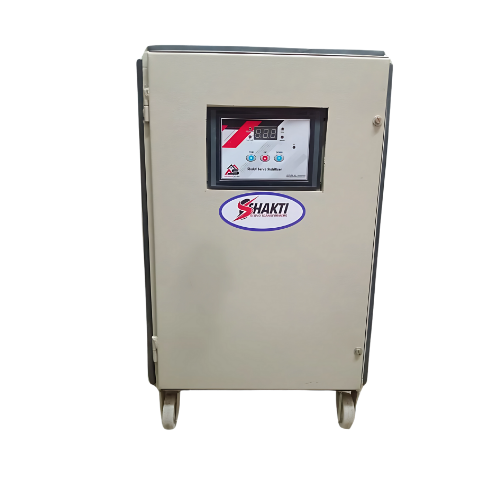
Modern villas and large independent houses run loads that were once seen only in commercial buildings. Many air conditioners, water pumps, geysers, kitchen appliances, home theatres, lifts and even electric vehicle chargers can all draw power at the same time. When the supply voltage is unstable, every one of these expensive systems pays the price. A properly sized 20 Kva Servo Stabilizer at the main panel is one of the simplest ways to protect them all.
Why Big Homes Face Bigger Voltage Problems
In a large home, many appliances run together, which raises the total current drawn from the supply. At peak hours this can pull voltage down, and long cable runs inside the house add more voltage drop for equipment far from the panel. At quiet times the opposite can happen, and voltage rises above normal.
The result is a daily cycle of stress on compressors, pumps and electronics. The damage is rarely dramatic. It shows up as air conditioners that fail early, pumps that burn out, flickering lights and control boards that need repeated repair.
What a 20 kVA Unit Gives a Large Home
A 20 Kva Single Phase Stabilizer gives a household with a heavy combined load a comfortable margin. It can carry many air conditioners together, absorb the start-up surge of pumps and compressors and still leave headroom for equipment you add later. One unit at the main panel protects every circuit behind it, which is tidier and often more economical than fitting a small stabilizer to each appliance.
For homes with separate distribution boards, such as one for each floor, a stabilizer can also be placed on the boards that carry the most valuable loads.
Single Phase Is Enough for Most Homes
Most residences, even very large ones, are supplied with single phase. A 20 Kva Servo Stabilizer Single Phase matches this connection directly, so there is no need to rewire the house for three phase. The unit takes a single-phase input, corrects it and delivers a steady single-phase output to your distribution board.
How a Servo Stabilizer Protects Your Appliances
A servo stabilizer monitors the output voltage all the time. When it drifts, a servo motor moves a carbon brush along a transformer winding, adjusting the output in small steps. The correction is smooth and continuous, with no sudden jumps. This is gentler on compressors, motors and electronic control boards than coarse stepped switching.
A delay timer adds more protection. After a power cut, it holds back the output for a short time, so air conditioners and refrigerators do not all restart into unstable voltage at once.
Air Cooling Suits Residential Spaces
The 20kVA Single Phase Air Cooled Servo Stabilizer sheds heat through air circulation instead of oil. For a home this has clear advantages:
- No oil to check, top up or dispose of
- No leak risk near floors, walls or stored items
- Simple servicing with very little routine upkeep
The one condition is ventilation. Install the unit in a shaded, open spot, such as a utility area or a ventilated electrical room, with space around the vents. Keep it away from direct sun, water splashes and stored boxes.
Understanding the Numbers: kVA and kW
Homeowners often work in kilowatts, which is why many people search for a Servo Stabilizer 20 Kilowatt. The two units are related but not the same. kVA is apparent power and kW is real power, linked by the power factor. At a typical factor of 0.8, a 20 kVA unit supports about 16 kW of real load. If your total is close to 20 kW, choose a larger unit or divide the load between two stabilizers, so that neither runs at its limit.
How to Calculate Your Home’s Load
- List every appliance with its power rating, including air conditioners, pumps, geysers, kitchen equipment, lighting and entertainment systems.
- Estimate what runs together. Not everything runs at full load at once, but evening peak hours matter.
- Add start-up surges for the largest compressors and pumps.
- Include a margin of 20 to 25 percent for safety and growth.
- Plan for the future. Extra rooms, new air conditioners and EV chargers all raise the load.
Features Worth Insisting On
- A wide input voltage range that covers deep peak-hour dips
- Overload and short-circuit protection
- High and low voltage cut-off
- A delay timer for compressor protection
- A bypass switch so power continues during servicing
- Digital display of input and output voltage
- Quality copper windings and a reliable control card
Installation and Care
Choose a dry, ventilated spot close to the main incoming supply. Use cables rated for the full load current, tighten all terminals and have a qualified electrician complete the earthing. For upkeep, clean the vents monthly, inspect connections every quarter and arrange an annual technician service for the carbon brush, winding track and control card. Avoid running the unit at its maximum rating all day, since headroom extends its life.
What a Stabilizer Does Not Do
A stabilizer corrects voltage but does not store energy, so it cannot keep the house running through a power cut. Many homes pair it with an inverter or generator for backup, and a small UPS for computers and networking equipment. The stabilizer then protects everything from voltage swings, while the backup covers actual outages.
Conclusion
A large home is a significant investment, and so is everything inside it. A properly sized 20 kVA servo stabilizer protects air conditioners, pumps, kitchens and electronics from the slow damage of unstable voltage. Calculate your real load, leave a safety margin, choose servo technology and give the unit good ventilation, and your home will run on steady power for years.