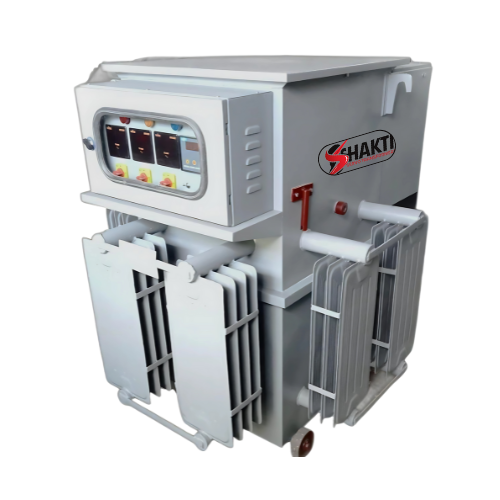
In environments where electrical stability is critical, even minor voltage fluctuations can lead to equipment malfunction or failure. A Linear Servo Stabilizer is specifically designed to provide highly accurate and smooth voltage correction, making it ideal for sensitive and precision-based applications. It ensures a constant output voltage, protecting valuable equipment and improving operational efficiency.
What is a Linear Servo Stabilizer?
A Linear Servo Stabilizer is an advanced type of voltage stabilizer that uses a linear correction mechanism to maintain consistent output voltage. Unlike conventional stabilizers, it offers step-less and continuous voltage regulation, ensuring higher precision.
This stabilizer is equipped with a servo motor that adjusts the voltage through a variable transformer, providing stable power even under fluctuating input conditions.
How Does a Linear Servo Stabilizer Work?
The working principle is based on a closed-loop feedback system:
- The stabilizer continuously monitors input voltage
- When fluctuations are detected, the control circuit activates the servo motor
- The servo motor adjusts the position of the carbon brush on the transformer
- This correction results in stable and precise output voltage
The linear movement ensures smooth and accurate voltage correction without sudden jumps.
Key Features of Linear Servo Stabilizers
Linear servo stabilizers are known for their advanced performance and reliability:
- High Precision Output: Maintains voltage within ±1% accuracy
- Step-less Voltage Correction: Smooth and continuous regulation
- Wide Input Range: Handles large voltage fluctuations
- Fast Response Time: Quickly corrects voltage changes
- Low Waveform Distortion: Maintains power quality
- Durable Design: Built for long-term industrial use
Applications of Linear Servo Stabilizers
These stabilizers are widely used in applications where voltage precision is essential:
1. Medical Equipment
Hospitals and diagnostic centers use linear servo stabilizers for equipment like MRI, CT scans, and lab instruments.
2. Industrial Machinery
Used in CNC machines, printing machines, and automation systems where stable voltage is critical.
3. IT and Data Centers
Protects servers, networking devices, and storage systems from voltage fluctuations.
4. Laboratories and Research Facilities
Ensures accurate readings and performance of sensitive instruments.
Benefits of Using a Linear Servo Stabilizer
Using a linear servo stabilizer offers several advantages:
- Enhanced Equipment Safety: Protects against voltage spikes and drops
- Improved Performance: Ensures smooth operation of sensitive devices
- Reduced Downtime: Minimizes equipment failure
- Energy Efficiency: Maintains optimal voltage levels
- Long Equipment Life: Prevents wear and tear caused by fluctuations
Types of Linear Servo Stabilizers
Based on usage and capacity, these stabilizers are available in:
- Single Phase Linear Servo Stabilizers – Suitable for small-scale applications
- Three Phase Linear Servo Stabilizers – Designed for industrial setups
- Air-Cooled Models – Ideal for indoor use
- Oil-Cooled Models – Best for heavy-duty and outdoor applications
Factors to Consider Before Buying
Before selecting a linear stabilizer, consider:
- Load Capacity: Match with connected equipment
- Input Voltage Range: Ensure compatibility with local supply
- Accuracy Requirement: Choose based on sensitivity of equipment
- Cooling Method: Air or oil depending on environment
- Installation Space: Indoor or outdoor setup
Maintenance Tips
To ensure long-lasting performance:
- Regularly inspect electrical connections
- Clean internal components to avoid dust buildup
- Check carbon brush condition
- Monitor oil levels (for oil-cooled models)
- Schedule periodic servicing
Conclusion
A Linear Servo Stabilizer is a highly efficient solution for maintaining precise voltage levels in sensitive and critical applications. Its step-less correction, high accuracy, and reliability make it a preferred choice for industries, healthcare, and IT sectors. Investing in the right stabilizer not only protects your equipment but also enhances performance and reduces operational costs. With proper selection and maintenance, a linear servo stabilizer ensures uninterrupted and efficient power management for years to come.
FAQs
1. What is the difference between linear and conventional servo stabilizers?
Linear stabilizers provide step-less and more precise voltage correction compared to conventional models.
2. Where are linear servo stabilizers used?
They are used in medical, industrial, IT, and laboratory applications.
3. What accuracy does a linear servo stabilizer provide?
Most models offer accuracy within ±1%.
4. Is it suitable for home use?
It can be used at home, but it is mainly designed for industrial and commercial purposes.
5. Does it require maintenance?
Yes, regular maintenance ensures optimal performance and longer lifespan.
Read More – Isolation Transformer Manufacturer in India: Complete Guide