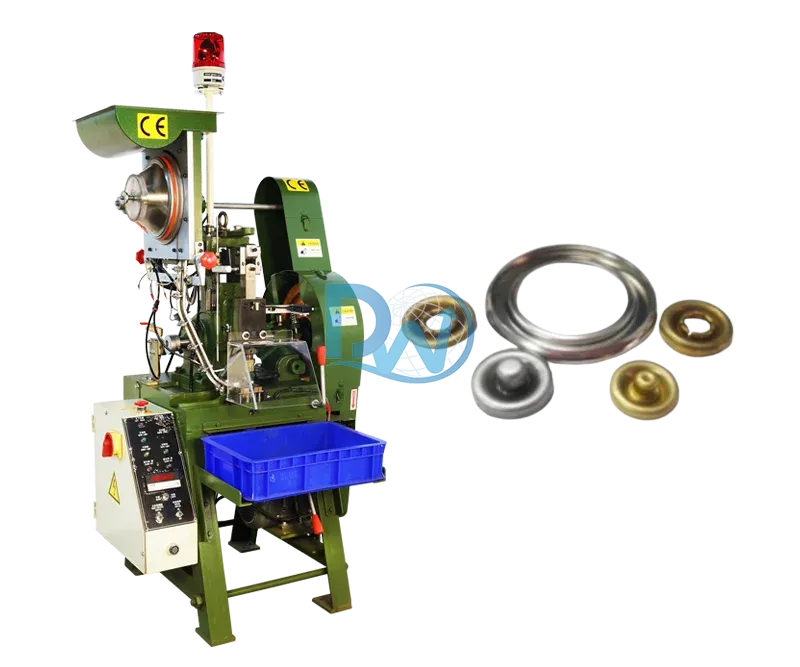
A snap button attaching machine is an essential piece of equipment for garment factories, tailoring units, leather-product manufacturers, footwear businesses, and accessory production facilities. It is designed to attach snap buttons, press studs, rivets, eyelets, hooks, and similar fasteners accurately and securely.
Using a snap button attaching machine helps manufacturers improve production speed, reduce manual effort, and maintain consistent fastening quality. It is suitable for products such as jackets, jeans, shirts, uniforms, baby garments, bags, wallets, belts, shoes, and fashion accessories.
How a Snap Button Attaching Machine Works
A snap button generally includes multiple components, such as a cap, socket, stud, and post. These components must be aligned correctly and pressed together with controlled force.
The machine uses an upper and lower die to hold the button parts in position. The operator places the fabric or leather between the components and activates the machine. Pressure is then applied to lock the fastener securely.
The die set must match the exact size and design of the button. Correct alignment and pressure help prevent loose buttons, damaged materials, scratches, and uneven fastening.
Manual Snap Button Machines
Manual machines are commonly operated with a hand lever. They are suitable for tailoring shops, home-based businesses, sampling departments, repair work, and small production units.
These machines are generally compact, affordable, and simple to maintain. They do not require electricity or compressed air, making them suitable for workplaces with limited infrastructure.
However, manual machines depend more on the operator’s effort and may not be the best choice for very large production volumes.
Foot-Operated and Pneumatic Machines
A foot-operated snap button attaching machine allows the operator to control the pressing action through a pedal. This keeps both hands free for positioning the garment or accessory.
Pneumatic machines use compressed air to generate pressure. They offer faster operation and more consistent fastening compared with many manual models. These machines are widely used in medium- and large-scale production facilities.
Pneumatic machines may include adjustable pressure settings, safety guards, pedal controls, and replaceable dies. Proper air supply and regular maintenance are necessary for reliable performance.
Automatic Snap Button Attaching Machines
Automatic machines are designed for factories handling high-volume orders. They may include automatic button feeding, accurate component placement, sensor-based operation, and adjustable speed controls.
These machines reduce repetitive manual work and help maintain uniform button placement throughout the production batch. Some models can automatically feed both the upper and lower button components.
Although automatic machines usually require a higher initial investment, they can improve productivity, reduce labour dependency, and lower fastening errors in large manufacturing units.
Industrial Applications
Snap button attaching machines are extensively used in garment production. They can be used for denim jackets, jeans, shirts, workwear, raincoats, uniforms, sportswear, children’s clothing, and fashion garments.
Leather-product manufacturers use them for handbags, wallets, belts, backpacks, pouches, luggage, and decorative accessories. They are also useful in footwear production for shoes, sandals, boots, and straps.
With suitable dies, some machines can attach rivets, eyelets, hooks, studs, and other metal or plastic accessories.
Advantages of Machine-Based Attachment
Machine attachment offers better consistency than hammer-based fastening. Controlled pressure helps create stronger joints while reducing damage to the button surface or base material.
The machine also improves working speed and supports higher production output. Operators can complete repeated fastening tasks with less physical strain.
Properly attached buttons improve the durability, appearance, and functionality of the finished product. Consistent fastening can also reduce rejection rates, rework, and material wastage.
Factors to Check Before Purchasing
Buyers should first consider their expected daily production capacity. Manual machines may be suitable for small orders, while pneumatic or automatic machines are more appropriate for continuous bulk production.
The machine must be compatible with the required button type and size. Buyers should provide button samples to the supplier so that the correct die set can be prepared.
Other important factors include adjustable pressure, safety features, machine structure, ease of operation, spare-part availability, energy consumption, maintenance requirements, warranty, and technical support.
Correct Pressure and Material Testing
Different materials require different pressure settings. Thin fabric can become damaged if excessive pressure is applied, while thick denim or leather may need stronger pressure for secure attachment.
Before beginning bulk production, operators should test the machine on a sample piece. The test should confirm button alignment, attachment strength, fabric condition, and surface finish.
Pressure should be adjusted gradually until the fastener remains secure without damaging the button or material.
Machine Maintenance and Safety
The machine should be cleaned regularly to remove fabric fibres, dust, oil, and small metal particles. Dies must also be inspected for wear, misalignment, and damage.
Moving components should be lubricated according to the manufacturer’s recommendations. Pneumatic machines require regular inspection of hoses, air connections, valves, and pressure settings.
Operators should keep their hands away from the pressing area and use the supplied guards or safety features. Proper training helps reduce accidents and improves production quality.
Frequently Asked Questions
Which industries use snap button attaching machines?
These machines are used in garments, leather goods, footwear, bags, accessories, uniforms, denim products, and fashion manufacturing.
Can the same machine attach different fasteners?
Many machines can attach different snap buttons, rivets, eyelets, or studs by changing the die set.
Does a manual machine require electricity?
Most hand-operated manual machines do not require electricity or compressed air.
Why is the die set important?
The die set holds and presses the button components. An incorrect die may damage the button or create weak attachment.
Are automatic machines suitable for small workshops?
Automatic machines are generally more suitable for high-volume factories. Small workshops may find manual or foot-operated models more economical.
What causes snap buttons to become loose?
Loose fastening may result from low pressure, incorrect dies, poor-quality buttons, improper alignment, or unsuitable material thickness.
Conclusion
A snap button attaching machine provides a faster, safer, and more consistent method of installing fasteners on garments, bags, footwear, and leather products. Different manual, foot-operated, pneumatic, and automatic models are available for varying production requirements.
Selecting the right snap button attaching machine, compatible dies, and suitable pressure settings can improve product quality and operational efficiency. Regular testing, operator training, and preventive maintenance can further support reliable long-term performance.