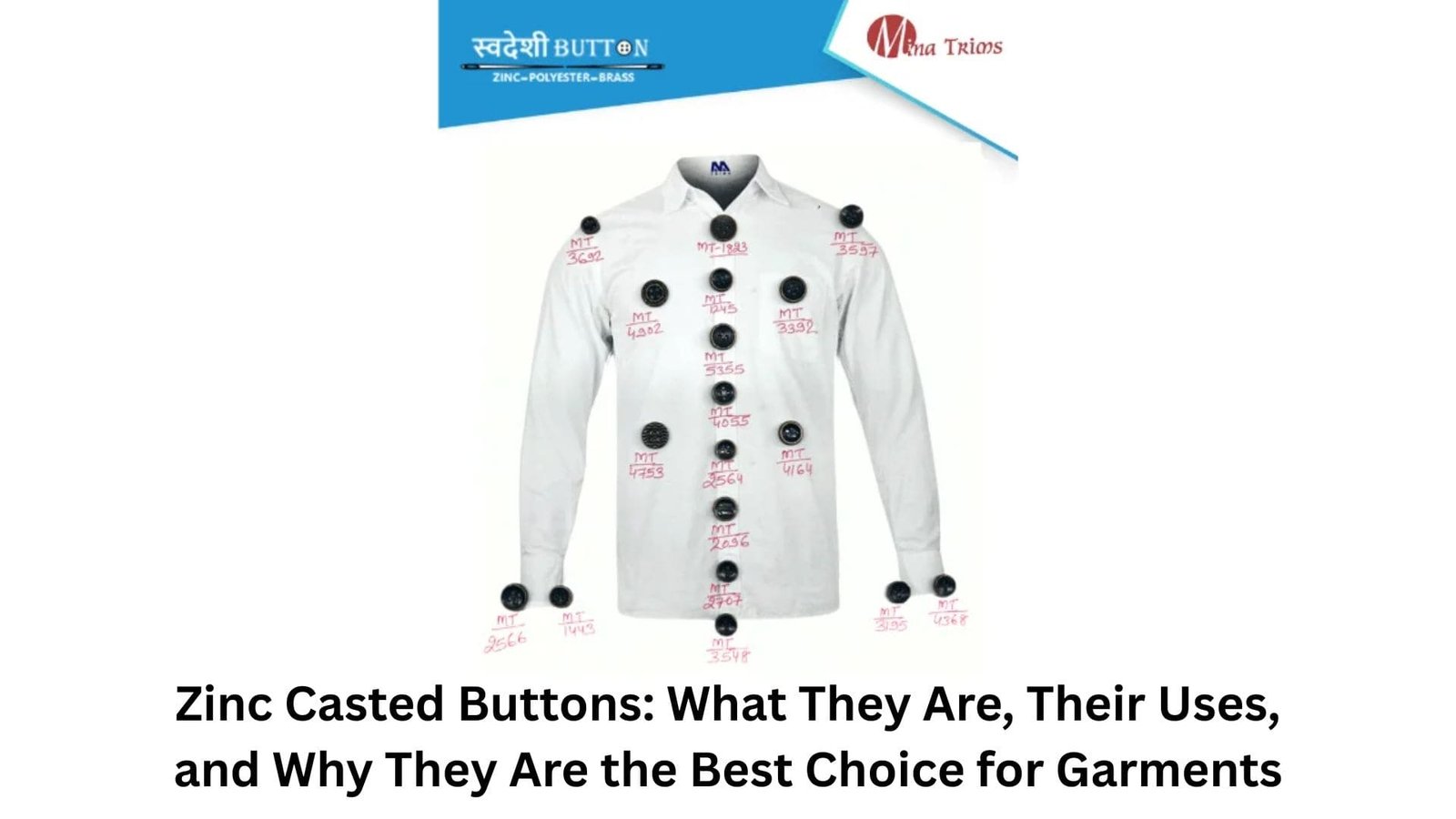
Ordering buttons in bulk looks simple until the first lot arrives with shade differences, short counts or finish defects. For garment brands, exporters and production units, a clear ordering process protects both the budget and the delivery schedule.
This guide walks through how to buy a metal button and polyester buttons in bulk, from briefing the supplier to approving the final lot.
Step 1: Define Your Requirement Before You Contact Suppliers
Manufacturers can quote accurately only when the brief is complete. Prepare these details first:
- Garment type: denim, jacket, shirt, blouse, uniform, coat or kidswear
- Button type: shank, snap, jeans button, two-hole, four-hole or fashion style
- Size: diameter in ligne, plus thickness where relevant
- Material: metal or polyester, and the finish you want
- Colour or plating: a fabric swatch for polyester, a finish reference for metal
- Quantity: total pieces, split by size and colour
- Logo or design: artwork file if you need a custom face
- Delivery date: the date your sewing line needs the buttons
A written specification also makes later quality disputes much easier to settle.
Step 2: Choose the Right Material for Each Garment
Many brands use both categories in one collection. A practical split looks like this:
- Use a metal button on denim, jackets, coats, workwear and branded fashion pieces where weight and a premium look matter.
- Use polyester buttons on shirts, blouses, suiting, kurtas and uniforms where colour matching and wash performance matter most.
You can review the full range of metal button manufacturing options for casted and plated styles, and compare them with the polyester button manufacturing collection before finalising material choices.
Step 3: Understand Minimum Order Quantity (MOQ)
MOQ depends on the type of button and the level of customisation.
- Standard designs usually have lower minimums because moulds or stock sizes already exist.
- Custom logo buttons need a new mould, so quantities are generally higher to justify tooling.
- Custom colours in polyester may require a dye or resin batch, which also affects minimums.
If you are a new or growing brand, ask whether the manufacturer offers a trial order or flexible quantities for first-time buyers.
Step 4: Request Samples and Approve Them Properly
Sampling is the most important control point in the whole process.
- Request a physical sample for every button you plan to order.
- Test it on the real fabric. Check how it sits, how it fastens and whether it pulls the cloth.
- Run a wash and pressing trial. This shows fading, cracking or finish loss early.
- Check metal buttons for plating quality, shank strength and edge smoothness.
- Check polyester buttons for shade accuracy, hole finish and surface polish.
- Keep a sealed approved sample to compare with the bulk lot later.
Experienced polyester button manufacturers are usually comfortable matching shades to a supplied swatch, but only an approved sample confirms the match.
Step 5: Compare Quotations Fairly
When you collect quotes, compare more than the unit price.
| What to compare | Why it matters |
|---|---|
| Unit price and size basis | Prices differ by size, thickness and finish |
| Tooling or mould charges | One-time cost for custom designs |
| Sampling charges and time | Affects your development schedule |
| Lead time | Drives your production calendar |
| Packing standard | Prevents damage and short counts |
| Payment and dispatch terms | Affects cash flow and logistics |
The lowest quote is not always the lowest cost. A cheap button that fails a wash test or arrives in mixed shades can cost far more in rework and returns.
Step 6: Plan Lead Times Realistically
Lead time covers sampling, approval, production, quality checks and dispatch. For custom metal designs, mould creation adds time. For polyester, colour matching and curing add time. Plan backwards from your garment production date and leave a buffer for approvals and any rework.
A reliable partner in metal button manufacturing will give you a clear timeline for each stage rather than a single vague delivery date.
Step 7: Set Quality Checks for the Bulk Lot
Agree on the inspection points before production starts.
For metal buttons:
- Plating consistency and tarnish resistance
- Shank or prong strength
- Size and weight uniformity
- Sharpness of logo or embossing
For polyester buttons:
- Colourfastness to washing and light
- Crack and heat resistance
- Hole alignment and smooth edges
- Lot-to-lot shade consistency
Ask the manufacturer how many pieces are sampled from each lot and what happens if a defect is found.
Step 8: Check Packing, Counting and Labelling
Short counts and mixed lots disrupt sewing lines. Confirm:
- Count per pack and per carton
- Separate labelling by size, colour and style
- Moisture-safe packing, especially for metal buttons
- Clear batch or lot marking for traceability
Common Mistakes to Avoid
- Ordering without a written specification
- Skipping the wash and pressing trial
- Approving a sample but not the bulk lot standard
- Choosing a supplier on price alone
- Not planning for shade variation across repeat orders
- Leaving packing and labelling details unclear
Frequently Asked Questions
What information do I need to get a quotation?
Share the button type, size, material, finish or colour, quantity, any logo artwork and your delivery date.
Is a sample always necessary?
Yes. A sample confirms size, finish, shade and performance on your actual fabric before bulk production begins.
Can I order both metal and polyester buttons from the same supplier?
Yes, many manufacturers handle both, which simplifies sourcing, communication and delivery for mixed collections.
How do I keep colour consistent across repeat orders?
Keep an approved reference piece and ask the manufacturer to match every new lot against it.
What affects the price most?
Size, material, finish, design complexity, tooling needs and order quantity are the main factors.
Final Thoughts
A good bulk order starts with a clear brief, an approved sample and an agreed set of quality checks. Whether you need a strong, premium metal button for outerwear or colour-matched polyester buttons for everyday apparel, working with capable manufacturers makes production smoother and more predictable.
Explore the metal button manufacturing range to see casted and plated options, and browse polyester button manufacturing to find shirt, blouse and suiting buttons. For bulk requirements, connect with polyester button manufacturers to request samples and quotations.