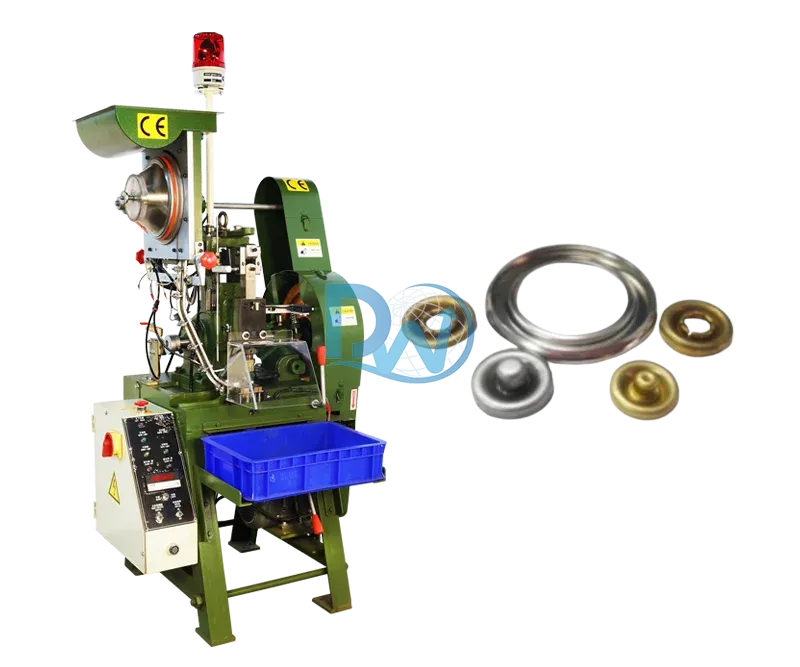
An Industrial Button Attaching Machine helps garment manufacturers attach buttons, snaps, rivets, studs, and other fasteners with greater speed and accuracy. It supports continuous apparel production by reducing manual effort and creating consistent attachment quality.
Garment factories use these machines for shirts, trousers, jeans, jackets, uniforms, babywear, sportswear, bags, footwear, and leather accessories. Different models are available for thread buttons, snap buttons, jeans buttons, metal fasteners, eyelets, and rivets.
A suitable machine can improve daily output, reduce rejected garments, and support faster order completion.
Role of Button Attaching Machines in Apparel Production
Button attachment is often completed during the finishing stage of garment manufacturing. Although buttons are small components, incorrect attachment can affect the appearance, strength, and usability of the entire product.
Manual installation becomes difficult when a factory handles hundreds or thousands of garments. Workers may apply unequal pressure, place buttons incorrectly, or create inconsistent stitching.
An industrial machine follows a controlled attachment cycle. It helps maintain similar button positioning, stitch formation, pressure, and fastening strength across every piece.
The equipment also reduces production delays. Garments can move smoothly from stitching and button attachment to inspection, ironing, packing, and dispatch.
How the Machine Completes Button Attachment
The working process depends on the button style and machine technology.
A sewing-based machine uses needle and thread to attach buttons containing two holes, four holes, or a shank. The operator places the garment and button under the holding clamp. The machine completes the selected stitch pattern and may automatically trim the thread.
A pressure-based machine uses a matched upper and lower die. The fabric and fastener components are positioned between the dies. The machine then applies controlled force to lock the components securely.
Manual machines use hand or foot pressure. Pneumatic models operate with compressed air, while electric and automatic machines use powered systems.
Advanced equipment may also include automatic button feeding, digital controls, safety sensors, production counters, adjustable pressure, and fault detection.
Different Industrial Machine Categories
Button Sewing Machine
A button sewing machine is mainly used for plastic, resin, wooden, or metal buttons that require thread attachment.
It is suitable for shirts, formal trousers, uniforms, coats, dresses, and children’s garments. Operators can adjust the stitch pattern according to the button structure.
Some models can also create a thread shank. This provides extra space between the button and fabric, making the garment easier to close.
Snap Button Attaching Machine
A snap button machine joins the male and female components of a snap fastener. It is commonly used for jackets, rainwear, sportswear, baby garments, workwear, bags, and uniforms.
Correct die selection is essential because every snap size requires matching upper and lower tools.
Jeans Button Machine
A jeans button machine attaches heavy metal tack buttons and rivets to denim garments. These fasteners require strong and precise pressure.
Manufacturers use this machine for jeans, denim jackets, trousers, workwear, canvas bags, and heavy clothing.
Pneumatic Button Machine
A pneumatic model uses compressed air to create uniform attachment pressure. It supports faster cycles and reduces the physical effort required from the operator.
Factories use it for snap buttons, rivets, eyelets, press studs, and other metal fasteners. Adjustable pressure makes it suitable for different fabric thicknesses.
Automatic Button Attaching Machine
An automatic machine is designed for large production units. It may feed, position, stitch, or press the button with limited operator involvement.
Automatic systems increase output and reduce repetitive handling. They are especially useful in factories producing standard garments in large quantities.
Advantages for Garment Businesses
An Industrial Button Attaching Machine helps manufacturers complete more garments during each production shift. Faster attachment supports bulk orders and strict delivery schedules.
The machine also creates uniform finishing. Buttons remain aligned, secure, and visually consistent across the production batch.
Controlled pressure and stitching can reduce fabric damage, broken buttons, loose fasteners, and incorrect placement. This lowers the need for repairs and rework.
Powered machines reduce operator fatigue because workers do not need to apply repeated manual force.
Many models also support interchangeable dies, feeders, or clamps. This allows businesses to handle different button sizes and styles using the same equipment.
Improved attachment quality can also reduce customer complaints and product returns.
Selecting a Suitable Machine
Buyers should begin by identifying the exact fastener they need to install. Thread buttons, snaps, rivets, eyelets, and jeans buttons require different machines or die systems.
Daily production volume should guide the level of automation. A manual machine may be suitable for limited work, while a pneumatic or automatic model may offer better value for continuous production.
The machine must support the required fabric types. Lightweight cotton, denim, canvas, leather, and multilayer materials require different pressure levels.
Adjustable settings provide greater flexibility. Buyers should check pressure control, stitch count, speed adjustment, cycle settings, and button-feeding options.
Die and spare-part availability are also important. A machine may remain unused during a breakdown when compatible parts are difficult to obtain.
Businesses should also check installation support, warranty conditions, operator training, and after-sales service before completing the purchase.
Quality Testing After Attachment
Manufacturers should inspect button quality before starting full production. A sample garment helps confirm whether the selected settings are suitable.
The button should remain straight and firmly fixed. It should not rotate excessively, become loose, or crack during attachment.
The surrounding fabric must remain free from tears, wrinkles, pressure marks, and deformation.
Factories can perform pull testing to check attachment strength. Wash testing may also be required for garments that will face repeated cleaning.
Random inspection during production helps identify faults before a large quantity is completed.
Machine Maintenance and Operator Safety
Regular cleaning helps maintain smooth machine performance. Operators should remove loose threads, fabric dust, metal particles, and other production waste.
Needles, dies, clamps, feeders, hooks, pressure regulators, and moving parts should be inspected at fixed intervals.
Worn dies may create weak attachments, while bent needles can damage the fabric or button.
Lubrication should follow the manufacturer’s instructions. Excessive oil may stain garments, while insufficient lubrication can increase friction.
Pneumatic machines require clean compressed air. Air filters, pipes, connectors, and pressure controls should remain in proper condition.
Operators must keep their hands away from the needle and pressing area. Electricity and compressed air should be disconnected before servicing or changing internal components.
Frequently Asked Questions
Which garments require an industrial button attaching machine?
The machine is used for shirts, jeans, trousers, jackets, uniforms, babywear, sportswear, bags, leather goods, and workwear.
Can the machine attach different button sizes?
Many machines can support different sizes by using interchangeable dies, clamps, feeders, or adjusted settings.
Which machine works best for snap fasteners?
A mechanical, pneumatic, or automatic snap button attaching machine with the correct die set is suitable.
Why do buttons become loose after attachment?
Low pressure, incorrect dies, poor alignment, damaged components, or unsuitable machine settings may cause loose buttons.
Can delicate fabric be damaged during attachment?
Yes. Excessive pressure or the wrong die may damage delicate fabric. Sample testing and accurate adjustment help prevent this problem.
Conclusion
An Industrial Button Attaching Machine improves attachment speed, consistency, strength, and overall garment quality. It helps factories process shirts, jeans, uniforms, jackets, bags, and several other products more efficiently.
Manufacturers should choose the machine according to their button type, fabric, daily production target, and automation requirements. Correct dies, trained operators, regular quality checks, and timely maintenance help the equipment deliver dependable performance during continuous garment production.