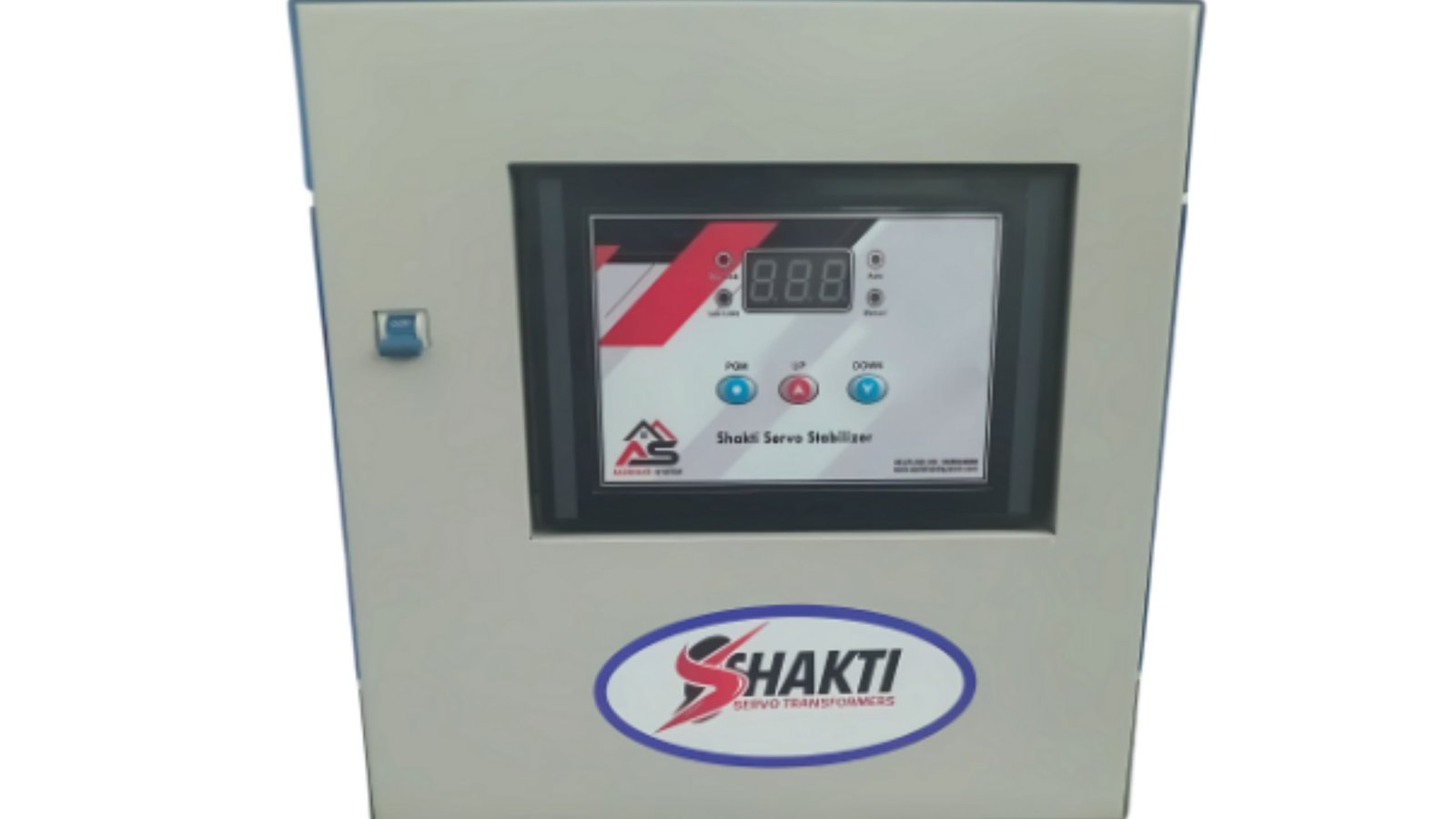
Servo stabilizer manufacturing involves the design, assembly, and production of automatic voltage stabilizers that protect electrical equipment from voltage fluctuations. These stabilizers are widely used in industrial, commercial, and residential applications to ensure stable power supply.
What is Servo Stabilizer Manufacturing?
Servo stabilizer manufacturing is the process of producing voltage regulation devices that automatically correct input voltage variations.
A servo stabilizer uses a servo motor, control circuit, and variac transformer to maintain a constant output voltage.
Manufacturers focus on accuracy, response time, load capacity, and long-term reliability.
How does Servo Stabilizer Manufacturing work?
- Voltage sensing: The input voltage is continuously monitored by a control circuit.
- Error detection: Voltage deviation from the set range is detected instantly.
- Servo motor activation: The servo motor rotates to adjust the variac transformer.
- Voltage correction: Output voltage is stabilized to the required level.
- Protection systems: Overload, short circuit, and thermal protection are applied.
- Final testing: Stabilizers are tested under varying load and voltage conditions.
Why is Servo Stabilizer Manufacturing important?
- Protects sensitive equipment from voltage fluctuations.
- Increases lifespan of machinery and electrical devices.
- Ensures uninterrupted industrial and commercial operations.
- Reduces power-related breakdowns and maintenance costs.
- Supports stable power supply in areas with inconsistent voltage.
Key facts and statistics
- Voltage fluctuations cause over 30% of electrical equipment failures in industrial setups.
- Servo stabilizers can maintain voltage accuracy within ±1% to ±2%.
- Industrial servo stabilizers range from 5 kVA to 10,000 kVA capacity.
- Demand for servo stabilizers grows with expanding industrial infrastructure.
- Energy losses are reduced by up to 15% with proper voltage regulation.
Common questions about Servo Stabilizer Manufacturing
Q1. What industries use servo stabilizers?
Ans. Manufacturing plants, hospitals, data centers, printing units, and commercial buildings.
Q2. What is the difference between servo and static stabilizers?
Ans. Servo stabilizers use a motor-driven variac, while static stabilizers use electronic components without moving parts.
Q3. How accurate are servo stabilizers?
Ans. Most servo stabilizers provide output accuracy between ±1% and ±2%.
Q4. Are servo stabilizers suitable for heavy machinery?
Ans. Yes. They are widely used for CNC machines, compressors, and industrial motors.
Q5. Do manufacturers offer customized servo stabilizers?
Ans. Yes. Servo stabilizers can be customized based on voltage range, capacity, and application.
Conclusion
Servo stabilizer manufacturing is essential for maintaining power quality and protecting electrical systems across industries. By delivering precise voltage regulation, improved efficiency, and reliable protection, servo stabilizers help reduce equipment damage and operational downtime. As industrial growth and power demand increase, high-quality servo stabilizer manufacturing remains a critical component of modern electrical infrastructure.